📰A Visual Support System For Student Success
One of the biggest challenges in teaching Algebra 1 is helping students retain and apply abstract concepts. From graphing linear inequalities to solving quadratic equations, there’s a lot to remember—and sometimes it feels like I am moving too fast for everything to stick. I needed some sort of Algebra reference set.
That’s why I started creating mini anchor charts.
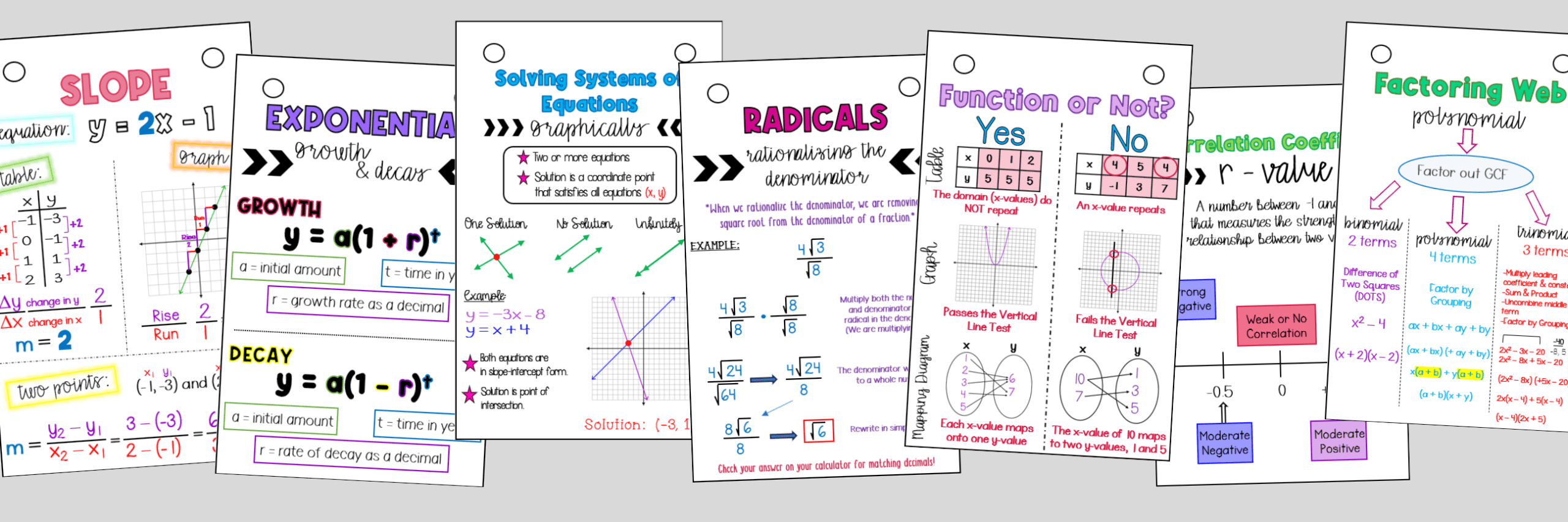
These compact visual references have been a game-changer in my classroom. After using them for a few units, I finally sat down last Spring and created a complete bundle for every major topic in Algebra 1—and I’m so excited to use them this upcoming school year. Let me show you how I use them and why they’re so effective.

✅ What Are Mini Anchor Charts?
Mini anchor charts are small, student-friendly versions of the full-size anchor charts many of us display on bulletin boards or walls. They are like an Algebra reference set that highlights key concepts, steps, vocabulary, and visual reminders—just in a smaller format that can be kept right at student tables or groups. I think of them as visual “cheat sheets” that help to promote independence and boost understanding without overwhelming your classroom space.

🎯 Mini Anchor Charts in the Algebra Classroom
Why Use Mini Anchor Charts in Algebra?
Here are just a few of the benefits I’ve seen firsthand:
Immediate reference – Students don’t have to raise their hand or flip through notes to remember whether to add or multiply the exponents or whether their graph gets a dashed or solid line. The reminder is right in front of them.
Supports retention – Visual repetition helps reinforce concepts over time.
Encourages independence – Instead of relying on me, students begin checking their anchor charts first—building confidence and problem-solving habits.
Great for group work – When students work in small groups, they often coach each other using the charts as guides.
Supports differentiation – Struggling students benefit from the extra scaffolding.
Cleaner classroom displays – Giant anchor charts take up a lot of room and I can often only hang one at a time. Mini versions are cleaner, more flexible and allow for multiple charts to be displayed during one unit!
How I Use Mini Anchor Charts in My Classroom
This year, I will be using a simple but effective setup:
My students sit in groups of three. Each group gets a set of mini anchor charts (depending on the current unit) hung in a white IKEA Tolsby frame using binder rings. These stand-up frames are perfect for small group tables. I rotate them out as we move through topics—such as Equations and Inequalities, Systems, Functions, Quadratics, etc. These frames are perfect because they:
✔️Stand upright at group tables and are easy to flip through
✔️Are durable enough to survive middle school students
✔️Can be quickly updated
✔️Don’t clutter the walls or whiteboard space
✔️Store easily in photo storage boxes
🎁Grab a Free Set: Equations & Inequalities
If you are interested in trying them, I’m sharing a free set of mini anchor charts for two of the most foundational units in Algebra 1:
➡️ Equations and Inequalities
These include:
The Equality Properties, Solving Multi-Step Equations with Variables on Both Sides, Number of Solutions, Solving Inequalities, Word Problems: Consecutive Integers, Word Problems: Coin Problems and Literal Equations

your free set
🧠 Final Thoughts
Do They “Give Away” the Answers?
No!
Mini anchor charts don’t give away answers; they provide support. They are an Algebra reference set that reinforces structure, vocabulary, and step-by-step thinking. In a high-stakes course like Algebra 1, students need reminders that don’t take away the thinking, but support their process.
Simple Tools, Lasting Impact
Mini anchor charts are a small shift that can make a big difference—especially in a fast-paced Algebra 1 curriculum. They help students feel more confident, stay on task, and retain what they learn. Whether you’re using them at group tables, in stations, or as part of small group instruction, these visual tools create a more student-centered and supportive learning environment.
Now that I’ve finished creating a full Algebra 1 Mini Anchor Chart Bundle, I’m so excited to use them consistently throughout the year—and even more excited to share them with other teachers like you.
If you try them out, I’d love to hear how they work in your classroom! Feel free to comment below, share this post, or tag me on social media. Let’s keep building math confidence—together!
{There are paid links in this post.}
Comments are closed